Harlow's Monkeys: The Cost and Revolution of Attachment Science
The recent viral sensation of Punch, a baby macaque at Japan's Ichikawa City Zoo, clinging to an orangutan plushie, tugged at heartstrings worldwide. Abandoned by his mother and rejected by his troop, Punch found solace and security in an inanimate object. While heartbreaking, Punch's story isn't just a feel-good moment; it's a poignant echo of groundbreaking, albeit controversial, psychological research from the 1950s that forever changed our understanding of love, connection, and child development. These were the infamous attachment theory monkey experiments conducted by American psychologist Harry Harlow, which demonstrated that contact comfort, not just food, forms the bedrock of attachment.
Harlow's work directly challenged the prevailing scientific wisdom of his time and laid the essential groundwork for modern Attachment Theory. His findings, while ethically problematic by today's standards, offered invaluable insights into the fundamental needs of infants and the profound impact of early relationships on psychological well-being. They revealed that the need for warmth, touch, and emotional security is as vital, if not more so, than basic sustenance for forming healthy bonds.
The Prevailing Wisdom: Behaviourism and Its Challenge
In the mid-20th century, the dominant psychological paradigm was behaviourism. This school of thought posited that all behaviours, including emotional bonds, were learned responses to environmental stimuli. When it came to infant-parent attachment, behaviourists argued that babies formed attachments primarily because their caregivers provided for their physiological needs – food, water, and shelter. A baby, in essence, loved its mother because she was the source of nourishment; the "love" was a secondary outcome of a reward-punishment cycle.
Harry Harlow, however, felt this explanation was incomplete and perhaps fundamentally flawed. He hypothesized that there was more to the parent-child bond than simply fulfilling biological demands. He believed that comfort, affection, and touch – what he termed "contact comfort" – played a crucial, perhaps even primary, role in the formation of attachment. To test this radical idea, Harlow devised a series of ingenious, though ultimately cruel, experiments using infant rhesus monkeys.
Harlow took newborn rhesus monkeys and immediately separated them from their biological mothers. These infants were then raised in isolation, but with access to two surrogate "mothers":
- The Wire Mother: This surrogate was constructed from wire mesh, shaped roughly like a monkey. Crucially, it was equipped with a feeding bottle, providing the infant monkeys with their essential nutritional sustenance. It was cold, hard, and offered no physical comfort.
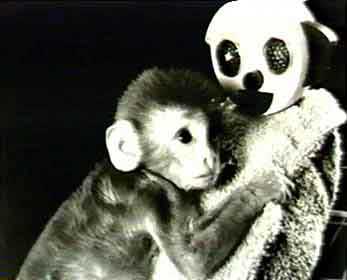
- The Cloth Mother: This second surrogate was also monkey-shaped but was covered in soft terry toweling. It offered warmth, softness, and a comforting surface to cling to, but it provided no food or drink whatsoever.
The design was simple yet profound: one "mother" provided everything a behaviourist would deem necessary for attachment (food), while the other provided only comfort. The question was, which would the infant monkeys prefer?
Contact Comfort: The Revolutionary Discovery
The results of Harlow's experiments were nothing short of revolutionary. Contrary to behaviourist predictions, the infant monkeys overwhelmingly preferred the cloth "mother." They spent significantly more time each day clinging to the soft, comforting figure, even when the wire "mother" was the sole source of their food. When frightened, the monkeys would rush to the cloth mother for security, only venturing to the wire mother briefly and as needed for nourishment.
Harlow's findings dramatically demonstrated that "contact comfort" was a far more powerful determinant of attachment than mere sustenance. The infant monkeys sought and found security and emotional solace in the soft, tactile presence of the cloth surrogate, even foregoing the immediate gratification of food for the warmth of a comforting embrace. This preference for emotional nourishment over purely physical sustenance completely upended the prevailing scientific view and fundamentally reoriented developmental psychology.
His work provided concrete evidence that babies, both primate and human, need more than just physical care; they need love, kindness, and touch to form healthy attachments. This pivotal insight became a foundational pillar for what would later become known as Attachment Theory, championed by psychologists like John Bowlby and Mary Ainsworth. Their work, building upon Harlow's controversial attachment theory monkey studies, further elucidated the dynamics of the parent-child bond and its long-term implications for psychological development.
The Unseen Scars: Ethical Considerations and Lasting Impact
While Harlow's experiments yielded profound scientific breakthroughs, their ethical implications remain a deeply troubling aspect of his legacy. The methods employed caused immense psychological suffering to the infant monkeys, and by today's research standards, these experiments would be considered unconscionable and forbidden. The "cost" of this scientific revolution was paid by the innocent subjects themselves.
The monkeys raised in isolation with only surrogate mothers exhibited severe developmental deficits. They displayed:
- Profound Social Impairments: They struggled to interact normally with other monkeys, often isolating themselves or engaging in aggressive or fearful behaviours.
- Self-Mutilation: Many monkeys engaged in self-harming behaviours, such as rocking compulsively or biting themselves.
- Maternal Deficits: When these monkeys later became mothers themselves, they were often neglectful, abusive, or indifferent to their own offspring, highlighting the intergenerational impact of early deprivation of normal attachment.
Harlow himself acknowledged the tragic consequences of his work, even naming some of his isolation chambers "pits of despair." The suffering endured by these monkeys spurred significant reforms in animal research ethics, leading to much stricter guidelines and regulations designed to protect animal welfare. It forced the scientific community to confront the moral dimensions of research and weigh the potential benefits against the undeniable harm caused.
The legacy of Harlow's attachment theory monkey experiments is thus complex: they provided indispensable insights that revolutionized our understanding of human development, yet they stand as a stark reminder of the ethical responsibilities inherent in scientific inquiry.
Modern Insights from Harlow's Legacy: Nurturing Secure Attachment
The fundamental principles revealed by Harlow's work continue to inform our understanding of attachment and child development today. The concept of "secure attachment," a cornerstone of modern Attachment Theory, emphasizes the importance of a caregiver's consistent responsiveness, sensitivity, and emotional availability. A securely attached child feels safe, valued, and knows that their needs will be met, fostering exploration and resilience.
Harlow's findings underscore that nurturing secure attachment goes far beyond simply providing food and shelter. It involves:
- Physical Affection: Cuddles, hugs, gentle touches, and carrying provide essential contact comfort that signals safety and love.
- Emotional Responsiveness: Attuning to a child's cries, smiles, and non-verbal cues, and responding appropriately to their emotional states.
- Consistent Presence: Being reliably there for a child, offering a stable and predictable source of comfort and security.
- Empathy and Validation: Acknowledging and validating a child's feelings, helping them understand and regulate their emotions.
These practices help children develop a "working model" of relationships as reliable and supportive, which influences their emotional regulation, social skills, and overall mental health throughout their lives. Even in cases where biological parents are absent, as with Punch the monkey, the provision of a substitute source of contact comfort – like his beloved plushie – highlights the innate, universal drive for connection and security.
Punch's enduring bond with his toy serves as a powerful, contemporary illustration of the very principles Harlow uncovered decades ago. His story, and countless others, reinforce that emotional nourishment is not a luxury, but a core psychological need for all primates, including humans. To learn more about Punch's specific situation, you can read Punch the Monkey's Viral Plushie and Attachment Theory Explained.
In conclusion, Harry Harlow's attachment theory monkey experiments represent a pivotal moment in the history of psychology. They courageously challenged a dominant paradigm, revealing the profound, primary importance of contact comfort and emotional connection in forming attachments. While the ethical shadows of these experiments can never be fully erased, the scientific revolution they ignited paved the way for a more humane and informed approach to childcare, emphasizing the critical role of love, touch, and responsiveness in fostering healthy development and well-being from infancy onward.